Table of Contents
introduction
Game Overview
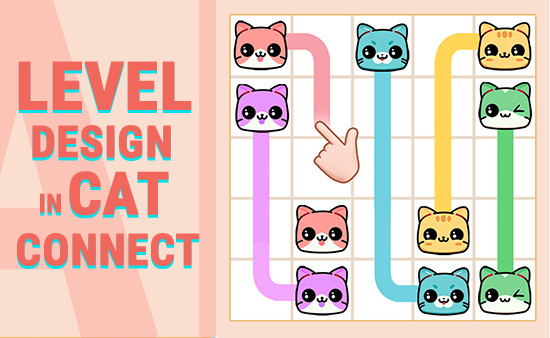
Cat Connect is a line-connect puzzle game where players connect matching colored cats across a predefined grid. The objective is to form valid connections while avoiding boxes that are already part of a path or occupied by other colored cats. While the AI Training paper focused on the agent solving and validating levels, this paper explores level design, specifically procedural level generation to create dynamic gameplay.
Problem Statement
Initially, levels were manually designed by designers and implemented by developers. This approach was slow and limited scalability. To address this, a procedural level generation strategy was developed. The goal was to create a smart algorithm capable of generating levels automatically, reducing dependency on designers and developers, and allowing dynamic, skill-based content delivery to users.
traditional level design vs. procedural approach
| Manual Approach | Procedural Approach |
| In a manual workflow, level designers create each level individually, carefully arranging layouts, obstacles, and paths based on their expertise and creative intent. These designs are then passed to developers for implementation, followed by rounds of manual testing to verify playability and balance. The process is highly labor-intensive, time-consuming, and limited in scale. | A procedural method replaces manual creation with intelligent algorithms that automatically generate levels based on predefined rules, constraints, and difficulty parameters. Instead of building each level from scratch, designers define the logic, boundaries, and desired experience, and the system produces endless variations that adhere to those requirements. |
Benefits
Benefits of procedural level generation include:
- Rapid creation: Generate thousands of unique levels in minutes for faster iteration.
- Adaptive difficulty: Levels adjust to player skill for a personalized challenge.
- Continuous improvement: Algorithms learn from player behavior to enhance quality.
- Fewer bottlenecks: Designers focus on creative tuning, not repetitive tasks.
- Consistent variety: Rules ensure quality while producing diverse layouts.
Level Generationn Algorithm
Algorithm Basics
The algorithm begins by placing two cats at specific points on the grid.
- The distance between each cat is assigned on the basis of level difficulty and grid size.
- Based on difficulty, the algorithm assigns movement patterns and variations to create multiple playable versions of the level. No go areas are verified in this part, the cells that the cat can move to are go areas.
Variants
Each level has two additional variants, which are transpositions of the original level.
- Variants are used to provide multiple challenges for the same base design.
- Player skills are categorized as average, above average, or below average to match user proficiency levels.
- For example, after gauging performance in Level 1, a below-average user may be presented with another variant of Level 1 rather than proceeding directly to Level 2.

Dynamic difficulty and user adaptation
Agent Evaluation
Once levels are generated, they are sent to the AI agent for thorough assessment. The agent performs several critical functions:
- Solving the levels: It navigates the grid using valid paths to determine whether the level can be completed successfully.
- Assigning difficulty tags: Based on metrics such as success ratios, and number of attempts, the agent categorizes each level as low, medium, or high difficulty.
- Validating playability: The agent checks for dead-ends, impossible routes, or conflicts within paths to ensure that each level is fully solvable and meets quality standards.
This evaluation process provides designers with objective, data-driven insights, reducing reliance on manual testing and ensuring consistent, playable levels.

Live Build Feedback
Once levels are deployed in the live build, user interactions are continuously monitored:
- Tracking performance: Player success rates, number of attempts, and completed wins are recorded to gather actionable insights.
- Dynamic level assignment: Levels are tailored to each player’s skill, ensuring an appropriate challenge that keeps engagement high.
- Personalized progression: The system adapts levels over time, creating a customized experience that evolves with the user’s abilities.
problems solved
The procedural level generation system tackles two key challenges:
- Reducing designer/developer dependency: Levels no longer need to be manually crafted and coded. The system automates level creation, saving time, minimizing human effort, and allowing designers and developers to focus on creative and strategic tasks.
- Dynamic, skill-based level delivery: Levels are personalized in real-time according to player performance, ensuring each player encounters challenges suited to their abilities. This approach enhances engagement, maintains an optimal learning curve, and delivers a more enjoyable gameplay experience.
Conclusion
Procedural level generation in Cat Connect enables scalable, dynamic, and skill-adaptive gameplay. By combining algorithmic generation, AI validation, and live user feedback, the system produces levels that are both challenging and engaging while minimizing manual effort. This approach ensures that every player experiences levels suited to their ability, creating a continuously evolving puzzle game environment.