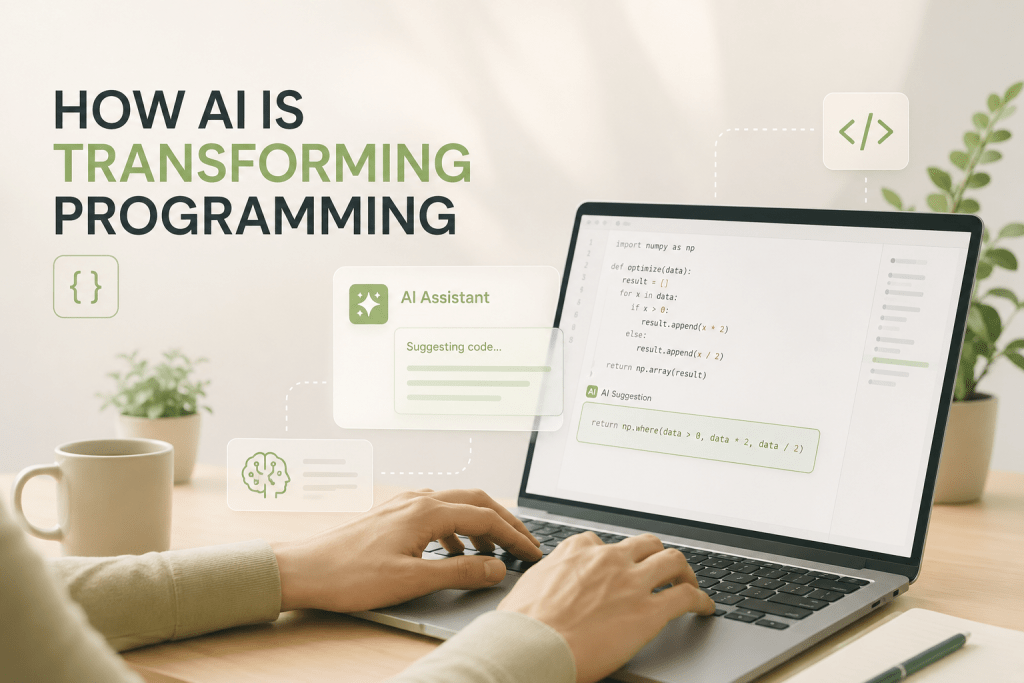
Artificial intelligence has rapidly become one of the most influential technologies in modern software development. Programming is entering a new era of human-AI collaboration. Instead of replacing developers, AI is taking over repetitive tasks so engineers can focus on building scalable systems, solving complex challenges, and creating better software. GitHub reports that developers using GitHub Copilot completed coding tasks up to 55% faster. Yet productivity tells only part of the story. Anthropic’s research suggests that while AI can accelerate software development, it may also alter how developers acquire and retain core engineering skills, particularly when AI is used as a substitute for problem-solving rather than a complement to it.
The question is no longer whether AI will change programming. It already has. The real question is how developers can adapt to make the most of this new era.
AI is now embedded throughout the software development lifecycle (SDLC), assisting developers from the earliest planning stages to deployment and maintenance.
Table of Contents
Where AI Delivers the Biggest Productivity Gains
The value of AI lies not in replacing developers, but in reducing the engineering effort required for routine implementation. However, these efficiency gains should not be viewed in isolation. Anthropic’s research found that while AI assistance modestly reduced task completion time, the improvement was not statistically significant in learning scenarios, suggesting that productivity gains depend heavily on the nature of the work being performed. AI appears to deliver the greatest value on repetitive or familiar tasks, where reducing implementation effort does not come at the expense of developing foundational engineering skills.
The Limitations of AI Generated Code
Despite its capabilities, AI should not be confused with engineering judgment.
While LLMs can generate functional code, they do so by identifying statistical patterns rather than understanding business objectives, system architecture, or operational constraints. As a result, generated code may appear technically sound while introducing logical errors, security vulnerabilities, or implementation choices that are unsuitable for production environments. These limitations become more pronounced in complex, large-scale systems where context, trade-offs, and domain knowledge are critical.
Beyond code quality, AI also presents a less visible challenge: skill development. In Anthropic’s randomized controlled trial, developers who relied on AI while learning a new programming library scored 17% lower on subsequent assessments than those who completed the same tasks without AI assistance. The largest gap emerged in debugging—one of the very skills developers need to validate AI-generated code. The findings suggest that excessive reliance on AI may reduce opportunities to develop the judgment required to supervise it effectively.
Human oversight therefore remains indispensable, not only to validate correctness, security, and performance, but also to ensure that technical decisions align with broader architectural and business requirements.
How the Role of Developers Is Evolving
The locus of value creation within software engineering is changing as developers are able to dedicate more time to architectural decision-making, platform design, and cross-system interoperability. These activities depend on contextual understanding and the ability to evaluate complex trade-offs; capabilities that remain difficult to automate.
This evolution also changes what differentiates effective developers. Anthropic’s research also found that participants who used AI to ask conceptual questions or request explanations retained substantially more knowledge than those who delegated entire coding tasks to the model. The implication is that competitive advantage will depend not only on access to AI, but on the ability to use it as a tool for reasoning rather than a replacement for it.
What’s Next?
The next generation of AI is moving beyond code suggestions toward intelligent software engineering agents capable of completing increasingly sophisticated tasks.
Future AI systems may autonomously:
- Resolve bugs across large codebases
- Generate complete applications from business requirements
- Coordinate multiple development tasks simultaneously
- Optimize cloud infrastructure
- Continuously improve software performance
- Assist with architectural decision-making
While these advancements will further automate aspects of development, they are unlikely to eliminate the need for software engineers altogether. Human creativity, strategic thinking, ethical judgment, and domain expertise remain essential for building software that solves real-world problems.
The future of programming is not about humans competing with AI, it’s about humans collaborating with AI to create better software faster than ever before.